 by Daniel Dice

In short: Thailand is enforcing its restrictions on nominee business and landholding arrangements. Thai shareholders acting as fronts to evade the law create legal risk; foreign funding or management alone does not establish a nominee offence. Consider a condominium or registered lease after independent legal review. [2]
The Complete Guide to Legal Property Ownership for Foreign Investors in the Kingdom of Thailand
Protect Your Property Investment in Thailand’s Changing Legal Landscape
Own Your Paradise with Confidence.
”Together, we’ll help you weigh every option through professional due diligence, transparent guidance, and the right legal ownership structure—so your investment is built on confidence, security, and lasting peace of mind.”

Introduction
Buying property in Thailand has long been one of the most attractive investments in Asia. Millions of international visitors fall in love with Phuket, Koh Samui, Krabi, Hua Hin, Bangkok and Pattaya and other destinations each year, with many deciding to purchase a second home, retirement villa or investment property.
However, one issue has always created uncertainty…
Can foreigners legally own land in Thailand?
For decades, various ownership structures have been promoted, including Thai nominee companies, leasehold arrangements, and other legal mechanisms.
Thailand’s 2026 enforcement includes company-registration safeguards and investigations into suspected nominee landholding. The specific measures are outlined below. [3] [4]
This guide explains:
✓ What Thai nominee companies actually are and how they are structured.
✓ Why the government is increasing enforcement.
✓ The legal risks involved.
✓ The alternatives available under Thai law.
✓ How to safeguard your investment.
Table of Contents:
- Understanding Thailand’s Land Ownership Laws
- What is a Thai Nominee Company?
- Why Nominee Structures Became Popular
- Why Thailand is Cracking Down
- Recent Government Enforcement
- How This Affects Existing Property Owners
- Understanding Leasehold (30+30+30)
- Legitimate Alternatives
- Due Diligence Before Buying
- Frequently Asked Questions
- Why Buy Through ParaDICE Properties?
- LEGAL NOTICE
- Insights:
- How ParaDICE Properties Protects International Buyers
- Buy Smarter. Buy Safer. Buy Through ParaDICE Properties.
- YouTube
- Frequently asked questions
- Official sources
Understanding Thailand’s Land Ownership Laws
Thailand has long welcomed international investment in its property market, particularly in destinations such as Phuket, where luxury villas, condominiums, and resort residences continue to attract buyers from around the world. However, Thailand’s land ownership laws differ from those in many Western countries.
Under Thai law, foreign individuals are generally not permitted to own land directly. This policy has existed for many decades and is intended to preserve national land ownership while still encouraging foreign investment through recognised legal structures.
Fortunately, there are several legitimate methods that enable foreign investors to enjoy long-term property rights and secure investments. These include foreign freehold condominium ownership (subject to statutory quotas), registered leasehold interests, and other legally recognised property rights that can be tailored to individual circumstances.
Understanding the available options before committing to a purchase is essential. With proper legal guidance and professional due diligence, foreign investors continue to purchase property successfully throughout Thailand every year. The key is ensuring that the ownership structure is appropriate, transparent, and fully compliant with Thai law.
What is a Thai Nominee Company?
In this property context, a nominee arrangement uses Thai shareholders as fronts for a foreigner to evade legal restrictions. Foreign participation, financing or management alone does not prove an unlawful arrangement; the actual ownership, funding and purpose must be assessed. [2]
Section 36 of the Foreign Business Act prohibits nominee shareholding used to enable a foreigner to circumvent that Act. Landholding must also comply separately with the Land Code. [1] [6]
Genuine business activity does not by itself establish eligibility to own land. Shareholding, funding and the applicable land and business rules must be checked together. [6]
Today’s investors are encouraged to focus on ownership structures that clearly comply with current Thai legislation. Obtaining independent legal advice before purchasing property provides clarity, protects your investment, and helps ensure that your ownership arrangement remains secure for the future.
Why Nominee Structures Became Popular
For many years, Thailand’s thriving property market attracted international buyers seeking holiday homes, retirement residences, and investment opportunities. As demand increased, various ownership structures were introduced to help foreigners participate in the market.
These arrangements can appear to offer practical control of a property. Widespread use or an adviser’s recommendation does not establish legality.
As Thailand’s property market has matured, the government has placed greater emphasis on ensuring that all ownership structures comply fully with existing legislation. This reflects a broader commitment to transparency, investor confidence, and the integrity of the country’s land registration system.
Buyers should request the ownership and funding documents rather than rely on assurances that a structure is common or accepted.
Why Thailand is Cracking Down
The Royal Thai Government has increased its focus on nominee arrangements as part of wider efforts to strengthen regulatory compliance, improve transparency, and protect the integrity of Thailand’s property and business sectors.
The government’s October 2026 announcement calls for evidence-based action against suspected nominee landholding while supporting legitimate investors. [4]
Greater scrutiny helps create a more transparent and professionally regulated property market, benefiting both domestic and international investors. A market built on clear legal foundations ultimately strengthens buyer confidence, supports sustainable long-term growth, and enhances Thailand’s reputation as a trusted investment destination.
For today’s purchasers, the message is straightforward: invest with confidence, but ensure your ownership structure is properly reviewed by qualified legal professionals before proceeding.
Recent Government Enforcement
DBD Order 2/2569 introduced investment explanations and three-month bank-statement evidence for covered company registrations involving foreign investment or signing authority, effective 1 August 2026. [3]
On 19 October 2026, the government announced nationwide action on suspected nominee landholdings, including examination of beneficial owners and financial links. Suspicion is not a court finding against every company. [4]
These measures enforce existing prohibitions and add registration checks. Due diligence can identify risks but cannot guarantee that a transaction will not be investigated.
The key takeaway is simple: choose experienced professionals, seek independent legal advice, and ensure your investment is structured correctly from the outset.
How This Affects Existing Property Owners
Existing ownership arrangements require individual review. Prior advice or good faith does not by itself establish compliance or remove legal exposure.
Owners who have questions about their existing ownership arrangements may benefit from obtaining an independent legal review to better understand their current position and, where appropriate, consider available options.
For prospective buyers, these developments simply reinforce the importance of carrying out comprehensive due diligence before purchasing. Taking the time to understand the legal structure of a transaction helps minimise future uncertainty and provides greater peace of mind.
Thailand remains one of Asia’s most attractive destinations for international property investment, and well-structured purchases continue to proceed successfully every day.
Understanding Leasehold (30+30+30)
A registered lease gives contractual rights to use property; it does not transfer ownership of the land. [5]
For an ordinary fixed-term immovable-property lease, section 540 generally limits the term to 30 years. Section 538 requires writing and registration for enforcement beyond three years. “30+30+30” is not a registered 90-year right. [5]
It is important to understand that while renewal clauses may form part of a private contract, future renewals are not automatically guaranteed under Thai law and generally require further legal steps at the relevant time.
Check the lessor’s title, authority to grant the lease, registration and renewal wording before committing funds. The suitability of the lease depends on the particular transaction.
Legitimate Alternatives
Foreign investors today have access to several recognised legal ownership options, depending upon the type of property being purchased and their individual circumstances.
Foreign freehold condominium ownership remains one of the most straightforward solutions where the development’s foreign ownership quota is available. Registered leasehold interests continue to provide long-term security for many villa purchasers, while other legally recognised rights—including usufructs and rights of superficies—may also be appropriate in specific situations.
A genuine company must still satisfy the Land Code’s ownership rules and applicable business restrictions. Genuine trading activity alone is not permission for a foreign-controlled landholding arrangement. [6] [1]
Selecting the most appropriate ownership structure is a decision that should always be made in consultation with an experienced independent Thai property lawyer who can advise according to the purchaser’s individual requirements.
Due Diligence Before Buying
Successful property investment begins long before signing a purchase agreement.
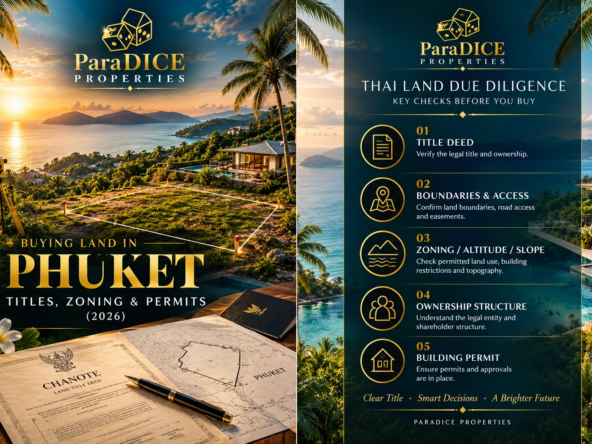
Professional due diligence helps verify land title, planning permissions, development approvals, ownership history, contractual obligations, developer credentials, and any legal matters that may affect the property.
Taking the time to investigate these matters before committing to a purchase can significantly reduce risk and provide greater confidence throughout the transaction process.
At ParaDICE Properties, we strongly encourage every client to undertake comprehensive independent legal due diligence before proceeding. An informed purchaser is a confident purchaser, and careful preparation helps protect what is often one of life’s most significant financial investments.
Frequently Asked Questions
Read the concise questions and answers below. Individual legal and tax decisions require independent advice.
Why Buy Through ParaDICE Properties?
Purchasing property overseas is one of the largest financial decisions many people will ever make. Choosing the right property is only part of the process—equally important is ensuring that the transaction is conducted transparently, professionally, and with appropriate legal safeguards.
At ParaDICE Properties, we place education, due diligence, and client protection at the heart of every transaction. We assist buyers by introducing carefully selected developments, providing detailed market knowledge, encouraging independent legal advice, and helping clients understand the ownership options available under Thai law.
Unlike many traditional agencies, our business model relies less on expensive advertising and more on professional referrals, organic marketing, and long-term client relationships. This allows us to offer our Strategic Buyers Rebate, through which qualifying purchasers may receive a 1% to 3% cash rebate following successful completion of their property purchase.
Our commitment is simple: to help you invest with confidence, transparency, and peace of mind while delivering exceptional value throughout your Phuket property journey.
LEGAL NOTICE
Important Disclaimer
This guide is provided for general educational purposes only and should not be regarded as legal or tax advice. Property ownership structures in Thailand depend upon individual circumstances. ParaDICE Properties strongly recommends that every purchaser obtains independent legal advice from a qualified Thai property lawyer before entering into any contractual agreement.
Insights:
⚖ Legal Insight
Compare ownership of a condominium with contractual lease rights before choosing a structure.
Investor Tip
Check title, encumbrances, permits and the seller’s authority before paying a deposit.
⚠ Important Warning
Do not treat Thai names on a shareholder list as proof that the funding and ownership are lawful.
✓ ParaDICE Properties Recommendation
Obtain independent legal advice and review the transaction documents before signing.
How ParaDICE Properties Protects International Buyers
Unlike many estate agencies, ParaDICE Properties believes every buyer deserves complete transparency before committing to a purchase.
Our role extends far beyond simply introducing properties. We work to reduce risk by helping clients understand ownership options, verifying the background of developments, coordinating independent due diligence, and introducing experienced legal professionals where appropriate.
Our objective is simple:
Helping clients purchase with confidence, clarity and peace of mind.
Buy Smarter. Buy Safer. Buy Through ParaDICE Properties.
Every qualifying purchaser may also benefit from our Strategic Buyers Rebate.
Depending upon the selected property and developer, buyers may receive a 1%–3% cash rebate following successful completion.
Ask ParaDICE Properties whether the selected property qualifies for the Strategic Buyers Rebate.
YouTube
Arrange a private consultation with one of our Phuket property specialists today.
Check the cited official sources and obtain independent advice on the particular transaction before signing.

Further reading
Frequently asked questions
Does foreign funding automatically make a company a nominee?
No. The facts and any circumvention must be assessed; a foreign loan or director alone is not proof. Thai shareholders acting as fronts to evade restrictions raise a different issue. [2]
What penalties can apply under section 36?
The statutory penalties include up to three years’ imprisonment, a fine of 100,000–1,000,000 baht, or both. The court also orders the relevant assistance, joint operation or shareholding to cease. [1]
Does “30+30+30” guarantee 90 years?
No. An ordinary fixed-term lease is generally limited to 30 years. Renewal requires a legally effective further arrangement; it is not automatic land ownership. [5]
What should an existing company property owner do?
Ask an independent Thai lawyer to review the title, shareholder records, funding evidence and business activity before changing the structure. There is no blanket assurance that an existing arrangement is lawful.
Official sources
- Foreign Business Act B.E. 2542, section 36 (BOI-hosted translation)
- Thai government: prohibition of nominee shareholding
- DBD: Order 2/2569, effective 1 August 2026
- Government PRD: nominee landholding enforcement, 19 October 2026
- Civil and Commercial Code, sections 538 and 540 (Thai text, government-hosted)
- OSMEP: land ownership guidance
- Thai government / REIC: condominium ownership quota