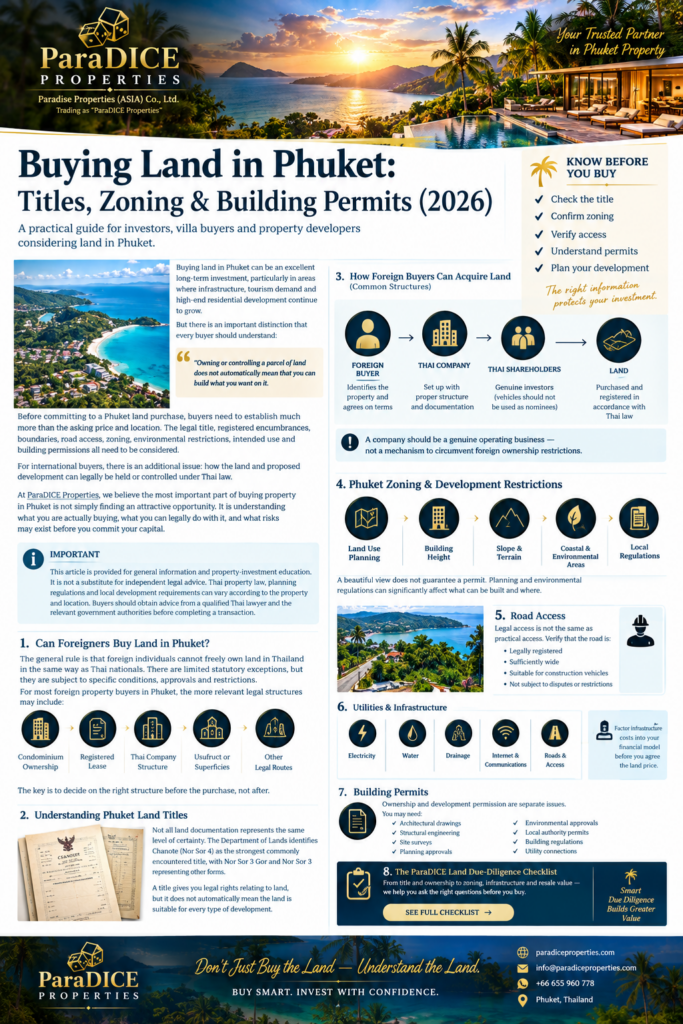
A practical guide for investors, villa buyers and property developers considering land in Phuket
Buying land in Phuket can be an excellent long-term investment, particularly in areas where infrastructure, tourism demand and high-end residential development continue to grow.
But there is an important distinction that every buyer should understand:
Owning or controlling a parcel of land does not automatically mean that you can build what you want on it.
Before committing to a Phuket land purchase, buyers need to establish much more than the asking price and location. The legal title, registered encumbrances, boundaries, road access, zoning, environmental restrictions, intended use and construction permissions all need to be considered.
For international buyers, there is an additional issue: how the land and proposed development can legally be held or controlled under Thai law.
At ParaDICE Properties, we believe the most important part of buying property in Phuket is not simply finding an attractive opportunity. It is understanding what you are actually buying, what you can legally do with it, and what risks may exist before you commit your capital.
This guide provides an overview of the principal issues to investigate in 2026.
Important: This article is provided for general information and property-investment education. It is not a substitute for independent legal advice. Thai property law, planning regulations and local development requirements can vary according to the property and location. Buyers should obtain advice from a qualified Thai lawyer and the relevant government authorities before completing a transaction.
1. Can Foreigners Buy Land in Phuket?
This is one of the first questions international buyers ask.
The general rule is that foreign individuals cannot freely own land in Thailand in the same way as Thai nationals.
There are limited statutory exceptions, but these are subject to specific conditions, approvals and restrictions. The Department of Lands confirms that Chanote is the strongest form of ordinary land title and also sets out the limited circumstances in which a foreigner may acquire land.
For most foreign property buyers in Phuket, the more relevant legal structures may therefore include:
- purchasing a condominium unit within the applicable foreign ownership quota;
- entering into a properly registered lease;
- acquiring or developing property through a genuine and legally compliant Thai company structure, where appropriate;
- using legal rights such as superficies or usufruct where suitable to the circumstances;
- or purchasing a property where the underlying land remains legally owned by an eligible Thai owner.
Thailand’s government information portal confirms the general 30-year maximum for ordinary registered leases and also recognises other routes to property occupation and ownership subject to Thai law.
The important point
The legal structure should be decided before the purchase rather than after it.
A buyer should never purchase land first and then attempt to find a structure that makes the transaction work.
2. Understanding Phuket Land Titles
Not all land documentation represents the same level of certainty.
The Department of Lands identifies Chanote (Nor Sor 4) as the strongest commonly encountered land title, with Nor Sor 3 Gor and Nor Sor 3 representing other forms of land documentation.
Chanote – Nor Sor 4
A Chanote is generally regarded as the preferred title for a conventional property transaction.
It identifies the parcel through a formal cadastral survey and provides the registered owner with recognised rights over the land, subject to any restrictions, encumbrances or other entries recorded against the title.
For a buyer, this is usually the starting point for a professional due-diligence process.
However:
A Chanote does not automatically mean that the land is suitable for every type of development.
That distinction is extremely important in Phuket.
Nor Sor 3 Gor
Nor Sor 3 Gor is another recognised land document with surveyed boundaries, although it is not equivalent to Chanote.
It can be encountered in property transactions and may, depending on the circumstances, provide a viable basis for ownership and future development.
The important point is not to judge a property solely by the name of the title.
The buyer needs to establish:
- exactly what rights the document provides;
- whether the boundaries have been properly established;
- whether there are outstanding issues or encumbrances;
- whether the land can be transferred;
- whether the proposed development is permitted; and
- whether the title can support the buyer’s intended use.
Nor Sor 3 and other land documents
Other forms of land documentation can present greater complexity.
This does not automatically mean that every parcel without Chanote is worthless, but it does mean that buyers should obtain professional verification before treating the property as equivalent to a conventional freehold development site.
The Department of Lands provides further information on Thailand’s principal land-title documents.
3. The Most Important Myth: “Chanote Means I Can Build”
It doesn’t.
A title establishes legal rights relating to land.
Planning and construction regulations determine what may actually be developed on that land.
A parcel can have a perfectly valid Chanote and still encounter restrictions relating to:
- land-use planning;
- building height;
- slope;
- environmental protection;
- coastal areas;
- access;
- road frontage;
- drainage;
- protected areas;
- infrastructure;
- utilities;
- building regulations;
- or the proposed use of the property.
This is particularly important in Phuket because the island contains a mixture of established urban areas, steep hillsides, coastal zones, agricultural land, environmentally sensitive areas and rapidly developing residential districts.
Consequently, a buyer should never rely solely on the seller’s statement that:
“You can build a villa here.”
The correct question is:
“Can the property be legally developed for the specific project we are proposing?”
4. Phuket Zoning & Development Restrictions
Before buying land for construction, the intended development should be assessed against the applicable planning and environmental requirements.
Depending on the location and project, this can involve consideration of:
Land-use planning
The applicable planning designation can affect what activities and buildings may be permitted.
Residential, commercial, hospitality and other uses can have different requirements.
Building height
The maximum permissible building height may vary according to the property’s location and applicable regulations.
This is particularly important for hillside and coastal developments where a buyer may have purchased the land partly because of its anticipated sea or mountain views.
Slope
Steep land can dramatically affect construction feasibility.
A plot may appear inexpensive on a per-square-metre basis but become considerably more expensive once retaining walls, foundations, drainage, access roads and other engineering requirements are considered.
Coastal and environmental controls
Properties near beaches, waterways, protected areas or environmentally sensitive locations can be subject to additional restrictions.
The fact that neighbouring properties have been developed does not necessarily mean that a new project will automatically receive the same permissions.
Local regulations
Development controls can involve several levels of government and local administration.
Therefore, a professional feasibility assessment should be carried out against the current regulations applicable to the specific parcel, rather than relying on a general rule found online.
5. Road Access: A Small Detail That Can Become a Major Problem
One of the most overlooked aspects of land due diligence is access.
A beautiful hillside plot may appear ideal until the buyer discovers that the road shown by the seller is:
- privately owned;
- not legally registered as an access right;
- too narrow for the proposed development;
- subject to a dispute;
- dependent on permission from another landowner; or
- unsuitable for construction vehicles and emergency access.
Legal access matters
A verbal statement such as:
“Everyone uses this road.”
is not the same as having a legally recognised right of access.
The title documents and Land Office records should therefore be examined to establish whether the property has appropriate access and whether any easements or rights of way are formally recorded.
This can be particularly important for landlocked plots.
Construction access
Even where legal access exists, another question remains:
Can construction equipment actually reach the site?
For a substantial villa or development project, consider:
- concrete trucks;
- cranes;
- excavators;
- delivery vehicles;
- fire-service access;
- drainage;
- electricity infrastructure;
- water supply.
An inexpensive plot with difficult access can become an expensive development.
6. Water, Electricity & Infrastructure
Before purchasing development land, investigate the practical infrastructure as carefully as the legal documentation.
Ask:
Electricity
Is there an existing electricity connection?
If not, how far away is the nearest suitable connection?
Water
Is government water available?
If not, what alternative supply is proposed?
Drainage
How will rainwater leave the property?
This can be particularly important on Phuket’s slopes during periods of heavy rainfall.
Internet and communications
For a luxury villa, residence or hospitality project, connectivity may be an important part of the property’s eventual marketability.
Roads
Who owns and maintains the access road?
Infrastructure costs should be incorporated into the financial model before the buyer agrees the land price.
7. Building Permits: Buying Land Is Only the Beginning
Once the legal and physical suitability of a site has been established, the proposed development must still satisfy the applicable building and planning requirements.
A construction project may require:
- architectural drawings;
- structural engineering;
- site surveys;
- drainage design;
- infrastructure planning;
- applications to the appropriate local authority;
- and, depending on the project, additional environmental or specialist approvals.
The precise requirements depend on the location, type and scale of development.
This is why an investor should distinguish between:
Land acquisition
and
development approval.
They are two separate stages.
A seller may legitimately own a parcel of land without having the right to construct the villa, apartment building, hotel or commercial project that a buyer has imagined for it.
8. The “30 + 30 + 30” Lease Question
Long-term lease structures are frequently discussed in Phuket property marketing.
The commonly advertised expression:
30 + 30 + 30 years
should be treated with considerable care.
Under Section 540 of the Thai Civil and Commercial Code, an ordinary lease of immovable property cannot simply create a registered lease exceeding 30 years at the outset.
A further lease can be entered into after the original term expires, subject to the law applicable at that time.
This distinction became particularly important following Supreme Court Decision No. 4655/2566, concerning a structure where a 30-year lease was accompanied by commitments for two additional 30-year periods, with the future rent effectively agreed and paid in advance. The Supreme Court found that those additional commitments were invalid in the circumstances of that case because they were designed to circumvent the statutory 30-year limit.
What does this mean for buyers?
It means buyers should not automatically treat:
“30 + 30 + 30”
as though they have purchased a guaranteed 90-year registered land right.
The precise wording, timing, registration and commercial circumstances of any lease arrangement matter.
A proposed lease should therefore be reviewed by an independent Thai property lawyer before signing or paying a substantial deposit.
9. Thai Companies & the Nominee Company Risk
Foreign investors sometimes hear that a Thai company can simply be established to purchase land.
That statement is far too simplistic.
There are legitimate Thai companies conducting genuine businesses with foreign participation.
However, a company structure should not be used as a disguise for prohibited foreign land ownership.
Where Thai shareholders are merely nominees or fronts for foreign investors, the structure can create serious legal problems.
Thailand has significantly increased scrutiny of suspected nominee arrangements, including investigations involving Phuket and other major property and tourism markets.
ParaDICE Properties has previously examined this issue in detail:
The principle is straightforward:
A company should be a genuine operating business with genuine ownership, funding and commercial substance — not a mechanism designed to circumvent Thai land-ownership restrictions.
For any company-based acquisition, independent Thai legal and corporate advice is essential.
10. Usufruct & Superficies
Depending on the circumstances, Thai law provides other legal mechanisms that may be relevant to property arrangements.
Two that buyers may encounter are:
Usufruct
A usufruct can provide a person with rights to use and enjoy property belonging to another person, subject to the applicable legal framework and registration requirements.
Superficies
A superficies can provide rights relating to ownership of buildings or structures constructed on land belonging to another party.
These structures can be useful in appropriate circumstances, but they are not interchangeable with land ownership.
Their suitability depends on:
- the parties involved;
- the intended use;
- the term;
- registration;
- inheritance considerations;
- financing;
- tax implications;
- and the specific property.
Again, this is an area where independent Thai legal advice is essential.
11. The ParaDICE Land Due-Diligence Checklist
Before committing to Phuket land, we recommend that buyers work through a structured checklist.
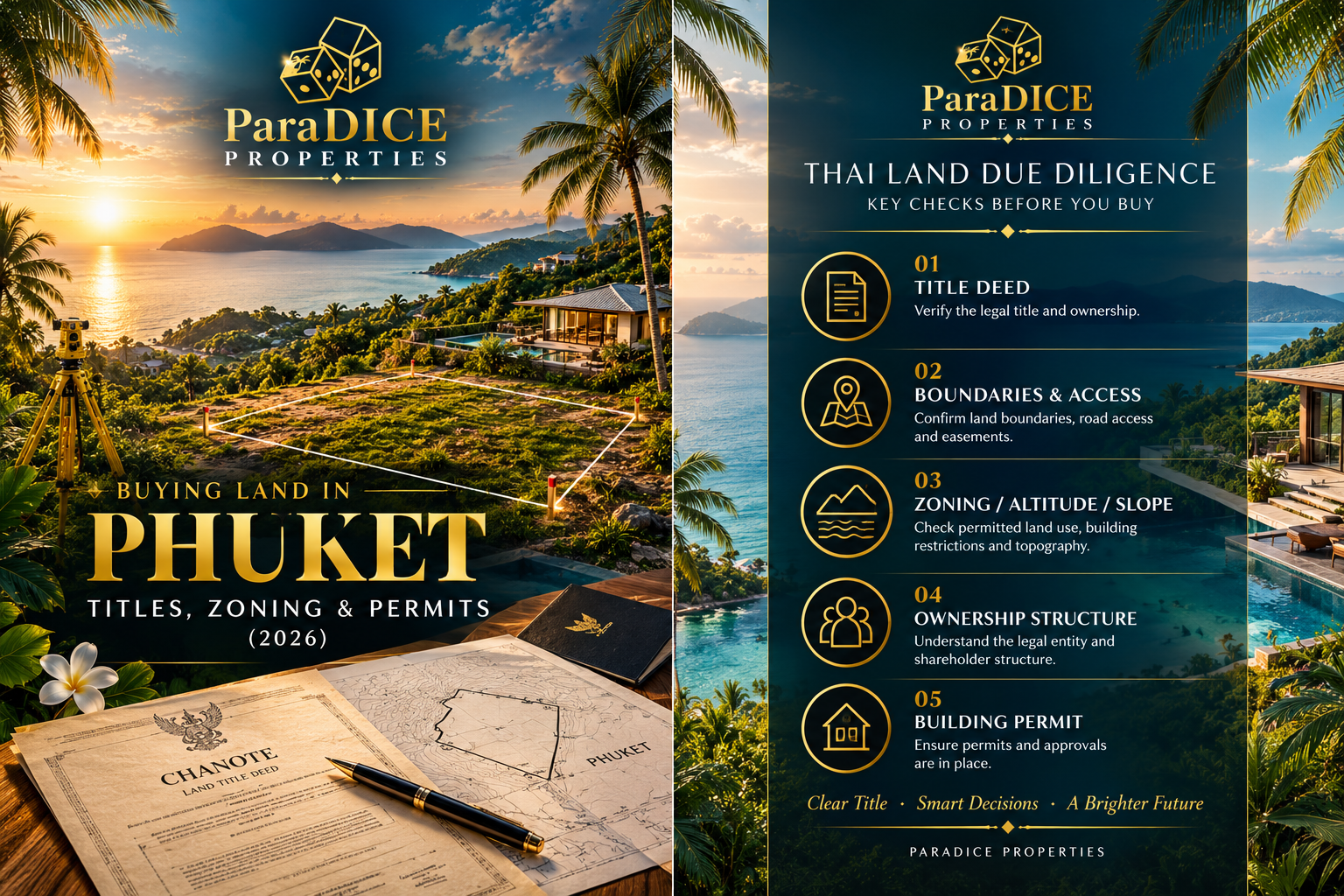
1. Verify the title
Obtain and independently examine the actual land documentation.
2. Verify the registered owner
Confirm that the person or entity selling the land is legally entitled to sell it.
3. Check encumbrances
Investigate mortgages, leases, usufructs, servitudes, restrictions, claims and other registered interests.
4. Verify the boundaries
Compare the title documentation with the physical site and, where appropriate, commission a professional survey.
5. Confirm legal access
Establish exactly how the property connects to the public road and whether access rights are formally recognised.
6. Check zoning
Determine what uses and development are permitted on the particular parcel.
7. Investigate environmental restrictions
Consider slope, elevation, coastline, waterways, protected areas and any other relevant restrictions.
8. Confirm infrastructure
Check electricity, water, drainage, telecommunications and construction access.
9. Test the proposed development
Before purchasing land specifically for a villa or development, have an architect or relevant professional assess whether the intended project is realistically achievable.
10. Establish the ownership structure
For foreign buyers, determine the legally appropriate method of holding or controlling the property before signing the purchase agreement.
11. Estimate the complete development cost
Do not evaluate land purely on its purchase price.
Include:
- legal fees;
- taxes and transfer costs;
- survey;
- architect;
- engineering;
- site preparation;
- retaining walls;
- foundations;
- utilities;
- construction;
- landscaping;
- financing;
- contingency.
12. Confirm the exit strategy
Ask how the property could eventually be sold, transferred, leased or inherited.
A property that is difficult to sell because of its legal structure or development restrictions may not be the investment it first appeared to be.
12. Cheap Phuket Land Can Become Expensive Land
One of the most common mistakes in land investment is comparing plots purely by price per square metre.
For example:
Plot A
THB 20 million
Flat land, good road access, utilities nearby and straightforward development potential.
Plot B
THB 12 million
Hillside land, difficult access, expensive retaining walls, infrastructure problems and significant planning restrictions.
At first glance, Plot B looks dramatically cheaper.
But if Plot B requires another THB 10 million in infrastructure and engineering costs, the apparent bargain may disappear.
This is why professional investors assess:
Land cost + development cost + legal risk + time + exit value
rather than land price alone.
13. Location Still Matters
Legal due diligence does not replace the fundamentals of property investment.
For Phuket, buyers should also consider:
- proximity to beaches;
- tourism infrastructure;
- international schools;
- hospitals;
- restaurants and retail;
- airports;
- road improvements;
- established villa communities;
- rental demand;
- future development;
- competing supply;
- and resale liquidity.
Areas such as Bang Tao, Laguna, Layan, Surin and Kamala can attract very different buyer profiles and investment strategies.
The correct question is therefore not simply:
“Is this land cheap?”
It is:
“Is this land legally secure, commercially viable and correctly priced for its intended use?”
14. Buying Land to Build a Phuket Villa
For buyers intending to construct a private villa, the due-diligence process should begin before the land purchase is completed.
A sensible sequence is:
Land identification
↓
Title & ownership verification
↓
Survey & boundary confirmation
↓
Access & infrastructure assessment
↓
Planning & development feasibility
↓
Preliminary architectural concept
↓
Ownership / legal structure
↓
Financial feasibility
↓
Purchase agreement
↓
Transfer / registration
↓
Detailed design & permit process
↓
Construction
This approach can save considerable time and expense.
15. Buying Land as an Investment
For investors, land should be evaluated differently from a personal residence.
Key questions include:
What is the realistic development potential?
A larger plot does not necessarily mean a larger development opportunity.
Who is the eventual buyer?
Luxury villa buyers, developers, hospitality operators and long-term investors may value different characteristics.
Is the legal structure transferable?
A property that is difficult to transfer may have a smaller resale market.
What happens if planning regulations change?
No investor should assume that today’s development assumptions will remain unchanged indefinitely.
What is the exit value?
The investment case should work backwards from the realistic end value rather than beginning with the purchase price alone.
16. The Five Questions We Would Ask Before Buying Phuket Land
At ParaDICE Properties, we believe every serious land buyer should be able to answer these five questions before committing significant capital:
1. What exactly am I buying?
Title, boundaries, ownership and registered rights.
2. Can I legally hold or control it?
Particularly important for foreign buyers.
3. What can legally be built or operated there?
Planning, zoning, environmental and building requirements.
4. What will the complete project actually cost?
Not simply the land price.
5. How easy will it be to sell later?
Legal structure, location, marketability and development potential all matter.
If any of these questions remains unanswered, the buyer should pause before proceeding.
Frequently Asked Questions
Can a foreigner buy land in Phuket?
Generally, foreign individuals cannot freely own Thai land, although Thai law provides limited exceptions subject to specific requirements. Other legal structures, including condominium ownership and properly registered lease arrangements, may be available depending on the circumstances.
Is Chanote the best land title in Thailand?
Chanote (Nor Sor 4) is generally regarded as the strongest commonly encountered title for private land ownership. However, having Chanote does not by itself establish that every proposed development is legally permitted.
Is Nor Sor 3 Gor safe to buy?
Nor Sor 3 Gor can represent legitimate land rights, but the particular property should be independently checked for title status, boundaries, transferability, encumbrances and development feasibility.
Can foreigners use a 30+30+30-year lease?
A 30-year registered lease is recognised under Thai law, while future renewal arrangements require careful legal analysis. Buyers should not automatically regard a 30+30+30 marketing description as equivalent to a guaranteed 90-year registered right. Supreme Court Decision No. 4655/2566 is an important warning in this area.
Does owning land mean I can build a villa?
No. Ownership and development permission are separate issues. Planning, environmental, building, access and other requirements must be assessed for the particular property.
Should I buy land through a Thai company?
There is no universal answer. A legitimate Thai company can operate lawfully, but a nominee arrangement designed to circumvent foreign ownership restrictions creates significant risk. Any company structure should be reviewed independently by qualified Thai legal and corporate professionals.
Do I need a lawyer when buying land in Phuket?
For a significant land acquisition, independent Thai legal advice is strongly recommended. The lawyer should act for the buyer rather than simply relying on the seller’s or developer’s legal representatives.
ParaDICE Properties: Don’t Just Buy the Land — Understand the Land
Phuket remains one of Asia’s most attractive property markets, but successful property investment is not simply about finding a beautiful location at an attractive price.
The strongest investments begin with good due diligence.
A property may have an excellent view, a Chanote title and an attractive asking price — yet still have limitations relating to access, zoning, construction, ownership structure or future resale.
For international buyers in particular, the objective should be to create a transaction that is:
Legally sound.
Commercially viable.
Properly documented.
Appropriately structured.
And suitable for the intended use.
At ParaDICE Properties, we help buyers identify and compare property opportunities across Phuket and can assist in coordinating the property, developer and professional due-diligence process.
We do not replace independent Thai legal advice. Rather, our objective is to help buyers ask the right questions before they commit their capital.
Don’t gamble on Phuket property.
Buy with knowledge.
Invest with confidence.
Buy smarter with ParaDICE Properties.
About ParaDICE Properties
Paradise Properties (ASIA) Co., Ltd.
Trading as “ParaDICE Properties”
Phuket Property Sales • Investment • Villas • Condominiums • Land
Website: ParaDICEProperties.com
Email: info@paradiceproperties.com
WhatsApp: +66 655 960 778
Internal links:
Ultimate Guide to Buying Property in Phuket (2026 Edition) AND Thailand Nominee Company Crackdown 2026